Adapting to the climate in Indonesia
Adjusting to new climatic conditions is key in any expatriation process. Moving to Indonesia is no exception.
What are the climate characteristics of Indonesia?
How does the local weather impact your daily life, mood or health?
What are the pros and cons of the climate in Indonesia?
Share you advice and help people adapt quickly to their new weather environment.
Thanks in advance,
Priscilla
- Life in Indonesia - Guide
- Food in Indonesia - 40 Replies
- How to adapt to the expat challenges of everyday life in Indonesia - 4 Replies
- Adapting to the pace of life in Indonesia - 5 Replies
- New in Indonesia - 8 Replies
- Safety in Indonesia - 54 Replies
- Women of Indonesia - 67 Replies
The rainy season sees hot weather, but then it rains like crazy and it cools down.
The dry season sees no rain worth a mention and temps hovering either side of 32 in the day, but can get as low as 26 at night.
High places can get cold, even seeing freezing on occasion in places like the Dieng plateau in Java.
Coping is easy.
If you have light skin, sun cream is essential or you'll burn like mad. That's easily available in supermarkets and many small shops,
A hat or cap is a good move.
I take several quick showers every day, most just being a two minute jobs to cool down and get rid of the sweat.
Air conditioning is a must in all lowland areas if you want to sleep at night.
As with all equatorial located countries, we only have two seasons鈥inter (aka, the dry season) and Summer, (aka the wet season).聽 Neither of these seasons exhibit the kind of extremes in climate experienced either further north or south of the equator.聽
In the most popular areas of Indonesia for expats, Java and Bali (but by no means they being exclusive), the climate is based on altitude.聽 Lower altitudes are far hotter in both seasons than are higher altitudes.聽 Bali is a perfect example of this phenomenon in that the lower coastal areas can be sweltering at any particular time whereas within a two hour drive to the central mountains, one will be looking for a sweater鈥hat area being significantly cooler.
A very clear advantage to living in Indonesia with its position on the equator is that violent weather like hurricanes, typhoons and cyclones is very rare.聽 The reason for this is because the temperatures of the waters in this area are typically not in great contrast to air temperatures, thus the energy needed to produce violent weather is not generally to be found here.聽
Anyone considering a move to Indonesia who has particular needs regarding climate is wise to study the specific areas of Indonesia they have in mind.聽 Unless easy and quick access to Alpine skiing is important to them, their 鈥渋deal鈥 climate can be found here.
If you access the site through the week at different times, the quality of air is no worse or better than some major western cities in the UK, USA and Europe which overall is good thing. The level of pollutants of course should be decreased in the city but if comparisons are made then its not much different except of course, its hot.
The site is
I live in one of those areas near mountains and with cooler temperatures than most of Indonesia. That means no need to use the aircon everyday, and actually it gets a bit chilly or fresh in the mornings and at night sometimes. However, we still get high temperatures like the rest of Indonesia although in general it is cooler and less humid.
The downside of living in Bandung is mainly that planes often have to circle around due to heavy cloud cover or bad weather before be able to land. Some planes even get diverted to Jakarta in worse case scenarios. So we learn to try to arrive or depart in the morning time when the weather is usually better. But something nice is that we can often drive around the city with the windows open which is something I could never do when I lived in Malaysia or Singapore.
So for expats who have the luxury of choosing where they want to live, it is definitely something to consider. Bandung is cooler and so is Bogor, although Bogor has a lot of rain. The higher parts of Bali like Kintamani also have quite a pleasant climate too.
Most other cities and towns with cooler temperatures are in more remote locations, such as Bukittinggi in West Sumatra and probably too remote for most expats. So I guess unless you can choose which city or town you wish to live in, you will probably end up living somewhere extremely hot and humid.
Regards,
Hansson
As anyone who knows Bali well will agree, the air quality here is fantastic as there is no local industry, or burning fields for palm plantations.聽 The exception would be if your neighbor decides to burn their trash鈥ut even that is becoming less and less of a common occurrence.
Beyond one鈥檚 lungs, the proof of Bali鈥檚 very high air quality can be seen at night by looking at the stars.聽 I鈥檝e never seen a night sky as beautiful as it is here in Bali aside from in Montana, USA.
I found that further revealed here:
鈥淔urther inland the city of Bandung records an average of 218 thunderstorm days annually, the most for any site in Asia.鈥
I鈥檓 not so sure how happy I would be living somewhere where the frequency of thunderstorms was more frequent than every other day, and the most frequent in all of Asia.聽
Here in Ubud, Bali we get on average 30 to 50 thunderstorms a year, and I surmise that's due to lesser extremes of hot and cold air colliding in the atmosphere.聽 And those storms are almost 100% limited to our wet, (hot) season, or about November to March.聽 Anywhere in Bali, a thunderstorm is a rare event from April to October.
Got my hydroponic chilies under artificial light for the first time this year
Comparing to other tropical countries such as Brasil, Thailand, Jamaica or Cuba,聽 humidity in Jakarta can be extreme during the rainy season.
I still remember attending a workshop of Lee Ritenour at Yamaha head-office in Jakarta, mentioning to the audience that the neck of his guitars became slightly bend in the 5 days he was here. He claimed it never happened to him in California.
If you live in an apartment it is wise to open the windows and curtains during the rainy season, whenever the rain stops. This to prevent high humidity during the night.
Also when sleeping with AC, try to set it on dehumidify, shown as a "drop" on the remote.
For the rest it is easy to adapt to the weather during the dry season, but I agree with what has mentioned above to buy a hat and some sun blocker when being in places such as Bali, or Semarang.
The sun gets pretty powerful so I tend to carry a sunblock much of the time.
I leave one in the car and one at home but also have a small bottle for when I'm walking around. No small bottles are available so I use a mosquito cream bottle filled with sunblock so it isn't too big to carry, but enough for a long walk.
The stuff is available in most pharmacies at a very reasonable price.
I also seem to spend a fair amount of time with new teachers explaining how sun cream works and when to apply it for the tropical sun because the sun is far stronger here than when on a beach in Tenerife.
She's right, but they are very comfortable.
Drinking ice cold water hits the mark for me, and I rarely take a hot shower, finding cold to be far more refreshing.
Avoid alcohol as that totally messes up your body's ability to regulate heat.
lukereg wrote:Being the delicate soul that I am I find that children's suncream and factor 50 is the only lotion that works for me here..
Skin tone and tanning over time change your body's ability to stand the sun.
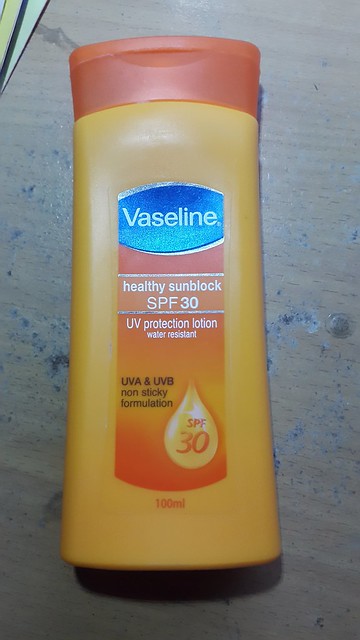
I use a factor 30 from Vaseline. It's cheap, available easily and works a treat for me.
I used to wear T-shirts and Polo Shirts but my wife told me I look messy so now I wear only cotton button shirts mostly with my Levis but occasionally with shorts. The climate in my part of Indonesia is not really hot so my shirts are mostly long sleeved.
I don't drink alcohol at all, and my wife persuade me to stop drinking ice cold water and to drink warm water instead, which she says is apparently better for the body.
My skin tone isn't lily-white and I tan rather than turn red, so I don't use Sun Tan Lotion. If I walk around during the day I just pick up a tan. But in the old days when I'd surf or windsurf for hours in the scorching sun, I'd use the strongest sun-block I could find. SPF30 or more is a must on a beach or in the sea. In fact, in Bali, if you're going to be out in the surf for a few hours then I'd advise anyone to wear a sunscreen vest otherwise you'll be raw red on the shoulders, back and face, no matter what your skin tone.
Cold water showers are the norm for me and my family as well but a nice glass of scotch does help the evenings and a few cold beers in an afternoon is always welcome.
I should wear good sunglasses more as the sun is often very bright but I tend to forget about them and I can never take good photos with a pair, so I often don't bother.
For sun tans, don't forget Ears and Noses and lips as they can burn really easily. Saying that, one of my colleagues just came back from the states red raw as he spent a few days in the mountain air fishing in a lake and forgot it was not Jakarta and how strong the sun truly is. However much we moan about the pollution here, ironically it does shield people from the strength of the sun somewhat.
Sunburns are nothing to mess around with.
Make your relocation easier with the Indonesia expat guide

Having a baby in Indonesia
If you're expecting, congratulations! And if you're specifically about to have your baby in Indonesia, then it's a ...

Working in Bali
The multi-faceted island of Bali offers many opportunities for those who wish to move from tourist to expatriate ...

Useful contacts and resources in Indonesia
When you're making a big move as an expat to Indonesia, you need to think about your health. Yes, even if you're ...

Working in Medan
Medan may lack obvious natural beauty, but the capital of North Sumatra makes up for it with its urban charm and ...

Dating in Indonesia
Dating and finding the right person is complicated in your home country鈥ut then moving to a more ...

Accommodation in Medan
Located on the island of Sumatra, in the Port of Belawan, Medan is recognized as the gateway to the wilds of North ...

Internships in Indonesia
Do you want to acquire hands-on experience, gain new professional skills and expand your international network for ...

Accommodation in Indonesia
Usually, expats living in Indonesia prefer to rent accommodation because of the limited duration of their stay and ...
Forum topics on living in Indonesia
大咖福利影院 for your expat journey