Construction Quality Control
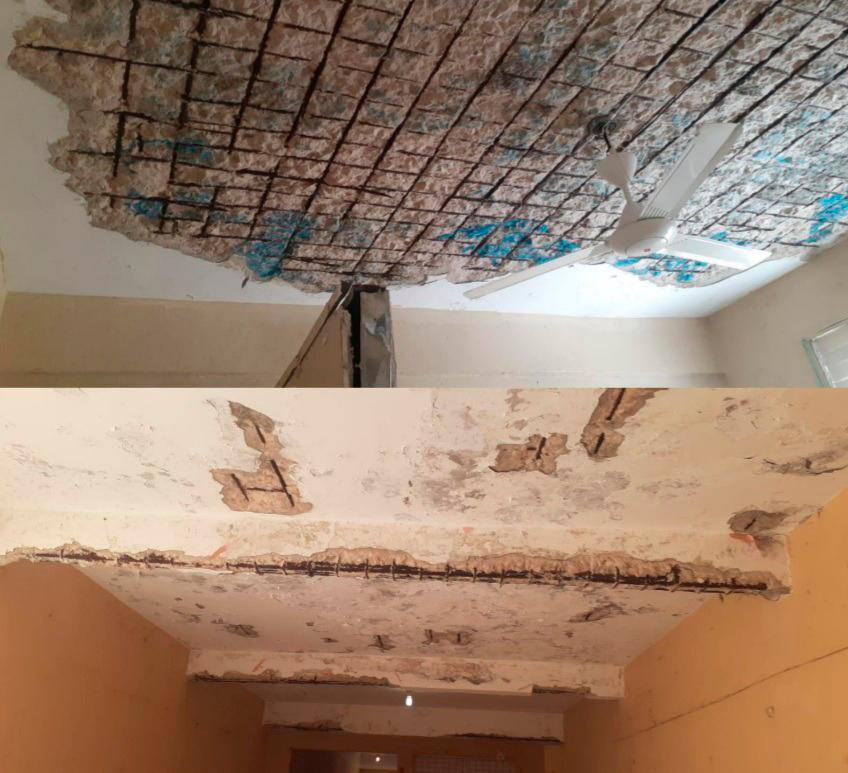
The report posted below which has followed damage froma relatively light earthquake in the Puerto Plata province, which is a high risk earthqauke, highlights the quality problems in masonry and concrete work.
The photograph shown tells me that the reinforced concrete work in that school was very poor with weak concrete (the colour suggest a low cement content and lack of compaction) and low poorly compacted concrete cover too to the reinforcement which has led to spalling after rusting. Puerto Plata along with much of DR needs higher levels of concrete cover to reinforcement to counteract the effects of salt air but it is poor uncompacted concrete that enhances any corrosion of the reinforcing bar which is essential to transmit tensile and shear forces.
You can't easily repair what is shown other than to demolish and rebuild.
Out of 10,000 schools, including new ones, 6,000 do not withstand a serious earthquake
290 of them need urgent intervention
They are located on top of tectonic faults
The northern region of the country is the most vulnerable

Of the 10,000 schools in the Dominican Republic, about 6,000 do not withstand a major earthquake, since they have not been built with an earthquake-resistant design, including the new ones that have been built since 2013, the year in which they began to invest 4% of the Gross Domestic Product in education. This represents 60% of a significant part of the workforce of educational centers nationwide.The physical structure of the schools is not equipped with a minimum number of elements in each direction, specifically placed to resist the onslaught of the forces of an earthquake of considerable magnitude, which are becoming more and more present in the Caribbean area.One evidence of this is what happened in Puerto Plata, where 13 schools were seriously affected in their structure by the earthquake registered in the early hours of Monday - 4.7............................
- Food and shopping in the Dominican Republic - Guide
- Quality of customer service in Dominican Republic - 16 Replies
- New construction - 22 Replies
- CONSTRUCTION BUDGET/ESTIMATION - 50 Replies
- ICF Home Construction 鈥 - 11 Replies
- Construction in the Dominican Republic - 15 Replies
- Septic systems for new construction - 20 Replies
If you are paying MOPC a fee they should inspect at key points but the above school photos suggest they aren't always thorough.
Your maestros are the key imo and that is where knowledge of Spanish comes in. Most expats involved in constructing their own properties will probably be dealing with a contractor who speaks in English but he relies on his maestros too.
lennoxnev wrote:You could get a cost for the structural engineer to visit at key times during the masonry and concrete construction.
If you are paying MOPC a fee they should inspect at key points but the above school photos suggest they aren't always thorough.
Your maestros are the key imo and that is where knowledge of Spanish comes in. Most expats involved in constructing their own properties will probably be dealing with a contractor who speaks in English but he relies on his maestros too.
Hi lennoxnev, in your experience, what is the best way to look for and contract a maestro de obra in the DR? I'm looking to build a site with some off grid infrastructure and most people I talk to suggetst to find someone in the capital even though the work is to be done in El Seibo.
El Seibo is a big enough provincial town and no doubt there is plenty of building work going on. You must have contacts in that town/province and by asking them is where you start to find your maestro.
I live in a sparsely populated part of DR in north Monte Plata province and have found two good general maestros one from our village and one from Sabana.
Once you identify the maestro he will identify best general construction materials and builders merchants. Spanish proficiancy or reliable Dominican friends will help.
And why would a maestro want to work in El Seibo where they would incur lodgings and dont know the local labour? But if you pay well they might consider.
I guess it depends what you are building.
I am not talking about contractors when I talk of maestros. I am referring to the local master builder who works on a labour only basis typically.
If you are looking for a good contractor perhaps you should look no further than La Romana. There are some very good ones there and they have their own maestros that they keep regularly employed. I can dig up a couple of names.
What is the difference between a maestro de obra and contractor? And who would be responsible for the quality control of the construction?
Both have been involved in Caso De Campo work.
In theory the best have a MOPC license.
Most building contractors employ several meastros and they will share out the work on a larger contract. The maaestro supplies, pays聽 and manages the labour and the contractor will have a contracts manager( perhaps non resident) to manage the work overall and order the materials etc.
For a smaller typical domestic building you save a lot by employing directly maestros on a labour only basis and buying the materials he will list for you.
A construction permit needs to be submitted by a CODIA registered person and that will normally be the architect or structural engineer.
The sitaution in DR is that at least 90% of all buildings, small and large, being or been built have no construction permit. I bet there are many ongoing constructions, especially the smaller ones, in El Seibo without a construction permit. Bigger building work usually has a buiding permit. In certain areas you will also need enviromental and tourism ministry permits too. There lies the problem with quality with no external checking. If you live here you will be able to check the work.
These things happen in DR......
Building roof collapses in the Senate

The collapse that occurred on Tuesday afternoon in the part of the roof of the construction of the new Senate dining room is kept in total secrecy.
In full execution of the work, the collapse occurred, with no reports of victims or serious damage.
However you can quickly determine the company M2Baltra is linked with Isotex Dominicana by clicking on 'contact' or googling M2Baltra and finding they are based at the Isotex premises in Santo Domingo.
Here is the Isotex website:
I would approach Isotex direct to get an approved contractors and quotation.
In DR traditional time tested construction is masonry and concrete and that explains why very few contractors will understand polystyrene based constuction. It could be to current DR seismic codes if the foundations to the聽 superstructure are designed accordingly and the overall design vetted by a certified CODIA structural engineer.
I have no experience of this form of construction but it will require a level of technical understanding and quality control in the building process. How do insurers view this form of construction? You must ensure the 'type of construction' is clearly defined in any all risks insurance policy because that will be the first item checked in any future claim for loss and if defined incorrectly could negate any claim. The underwriters could seize at the opportunity to knock back any claim if it is defined as masonry construction because it is not even though it may have a sand cement render finish (been there working with and as a loss adjuster in St Croix after windstorm claims following Maria).
brodies2013 wrote:We are going to build with the M2 panels. Developed in Italy to withstand seismic activity. (35+ years building around Mediterranean and Latin America) They have a factory in Santo Domingo. But is hard to find people well versed in how to build with them. But they are around.
Our builder in LT pitched M2 panels to us for our top floor. I think that was around May. The issue at the time was sourcing raw materials for concrete so M2 solved the problem for the most part. By the time they got to the 2nd floor construction they abandoned M2 and built with concrete block. We were looking forward to using M2 and I was a bit disappointed. There are many advantages to using it and our builder appeared to be knowledgeable about it. I believe the Puerto Plaza "ships" buildings in town are built with M2 construction, so it's around. There may be other issues with it here though, as Lennox indicates.
And whilst structurally it may work in seismic stress, how is it fireproofed adequately? Do they use rated fireboard detailing to internal and external finishes to give one hour rating? Will you need forced ventilation because of airtight construction? Will the labour applying the sand cement render externally do a good job to ensure water tightness. Will the resale value be affected because of potential limitations in remodelling? What additional warranties come with this type of construction? All questions I would be asking.
The key is that you need a skilled trained team who understand this type of building. And if it ever got damaged you would need an equally skilled trained team.
I am a sceptic because back in the 80s, everyone was pushing composite steel/drywall/stucco framed buildings. I was involved in the building of one such hotel in Grand Cayman in the 80s which is now no more. It didnt stand the test of time and was demolished. The University of West Indies in St Croix of like construction got severely damaged by Maria a few years back along with other apartment. Lots of damage and claims still ongoing today. Masonry buildings are still all around us and have stood up to the worst weather could throw at it. The only time I have thought about non standard forms of construction was when trying to maximise profit and minimize costs for contractors and developers.
There are buildings built successfuly this way on the North Coast so dont be put off by my questions and uncertainties. Do your due diligence. Start by researching where these panels are likely聽 made at Isotex and what is the M2 link as I have posted above is my advice.
Most render work here is done by Haitians who over cement the stucco mix and throw it onto saturated and often bonded blockwork for the base coat. No pumping here.
With an EPS structure I guess the installer uses a tar paper backed expanded metal mesh fixed to the polystyrene to provide something to which the stucco adheres. So getting the uniformity of sand cement finish with no masonry backing would appear key to good waterproofing.
Another question. How do they secure windows and doors to a polystyrene core at openings? Worth asking. I was renting an apartment built of polystyrene in Providenciales when Ike hit the island and couldnt fix ply hurricane protection externally to the openings - nothing to fix to except 3/4 inch of stucco. So must be same at all openings unless steel framed?
My husband is German ( he has built and renovated houses in Germany and the US with his own hands) and knows the system from Europe and the necessary procedure to get the concrete coating done correctly. He visited the factory in SD and was impressed, also there is a French- Canadian builder doing a project exclusively with the M2 panels near us. As I understand it through our research, many of your concerns are not applicable. There are high rise apartment buildings in capital (and around the world) built with these panels. Uncle Buck鈥檚 house in Casa Linda was built with M2 panels鈥hat鈥檚 how we met鈥
Having seen a severe hurricane rip stucco coatings attached to ply and metal sub frames, I simply prefer the time proven super strong full bond stucco has on concrete and concrete block when used in the tropics and for many reasons.
We are in the climate change age of super storms that can rip bark from trees.
My preference from 20 years working in the
Caribbean and tropics is clearly not your choice.
Good luck.
One negative we definitely will plan for is the faraday cage effect 鈥ell phone and WiFi signals can be blocked鈥 so you need wires and access points in select locations鈥 I guess we鈥檒l find out!聽

Make your relocation easier with the Dominican Republic expat guide

Death in the Dominican Republic
What customs and procedures are common when dealing with death in the Dominican Republic? Find more about it in ...

Education in the Dominican Republic
This article will cover the Dominican Republic's educational system, including public schools attended by 80% ...

Living and accommodation on the South Coast of the Dominican Republic
Along the south coast of the Dominican Republic, going from East to West, you will find the sugar town of La ...

Birth in the Dominican Republic
This article provides some information about the culture and the customs of Dominicans when giving birth and ...

Moving with your pets to the Dominican Republic
Many folks wish to bring their dogs and cats to the Dominican Republic, and this article will explain exactly what ...

Food and shopping in the Dominican Republic
It is well worth exploring the Dominican cuisine and shopping options, and note what they buy and where they shop, ...

Living and accommodation in the up and coming Southwest of the Dominican Republic
Barahona, for some, might be Santa Cruz de Barahona, is the biggest city in this region. However, not yet a ...

Pregnancy in the Dominican Republic
Are you ready to expand your family in the Dominican Republic (DR)? This article should provide you with all the ...
Forum topics on living in Dominican Republic
大咖福利影院 for your expat journey